Paired DeepFluoro and Ljubljana comparison#
This report records 382 matched projections generated with the CUDA/Slang X-ray
simulator from PR #73,
at commit 9ebb85e0e0c8e919bd28650f7f9f4171f6499cb1. The run finished on
2026-10-05 UTC with no failed subjects: 362 eligible DeepFluoro views from six
subjects and 20 primary Ljubljana views from ten subjects.
Both datasets show strong structural agreement. This run uses the dataset adapter's corrected geometry: the principal point is placed from the stored offsets with the correct horizontal sign, and DeepFluoro voxels are placed where that release's poses expect them. The previous version of this report found the Ljubljana horizontal displacement that led to the first correction; see Changes since the previous report. These results do not establish physical scanner calibration or independently validate X-ray and fluoroscopy realism.
Results#
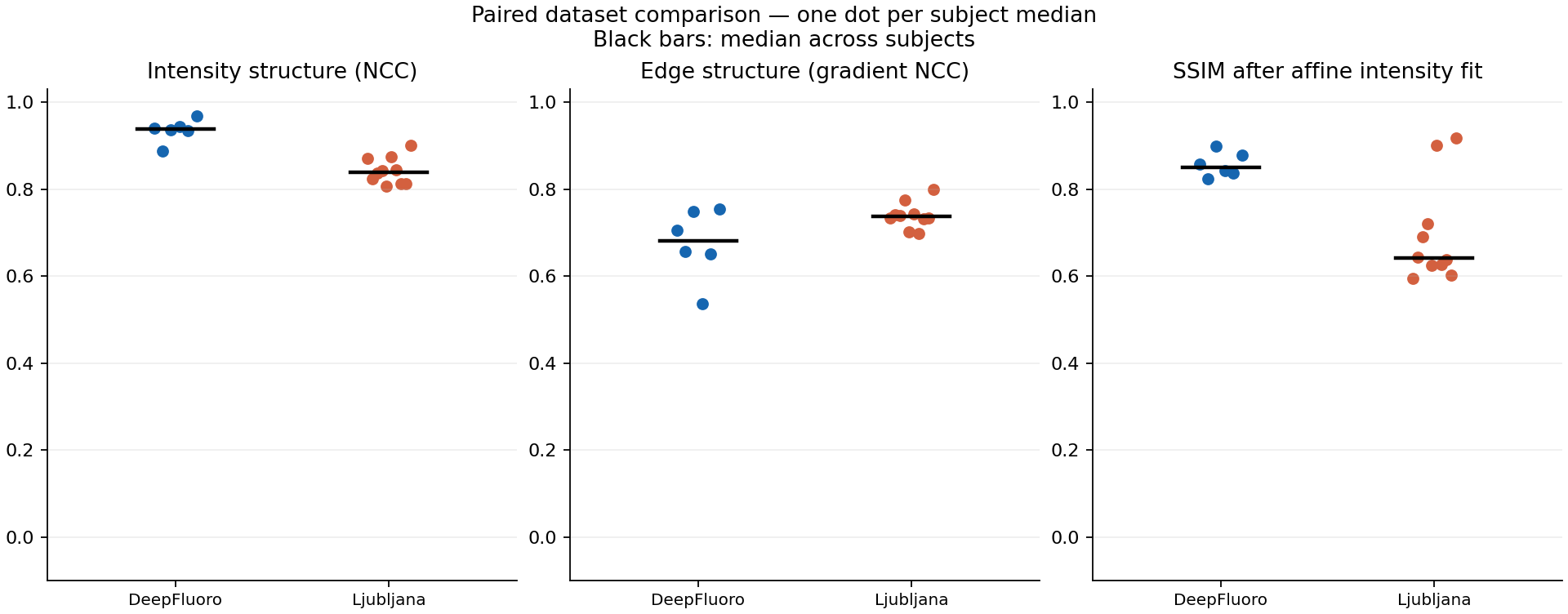
Values are medians of the per-subject medians, giving each subject equal weight. Higher NCC and gradient NCC indicate better structural agreement. Shape SSIM includes an in-sample nonnegative gain/bias fit and does not establish calibrated intensity. No acceptance threshold was specified.
| Dataset | Subjects | Views | NCC | Gradient NCC | Shape SSIM | Matched beats misposed |
|---|---|---|---|---|---|---|
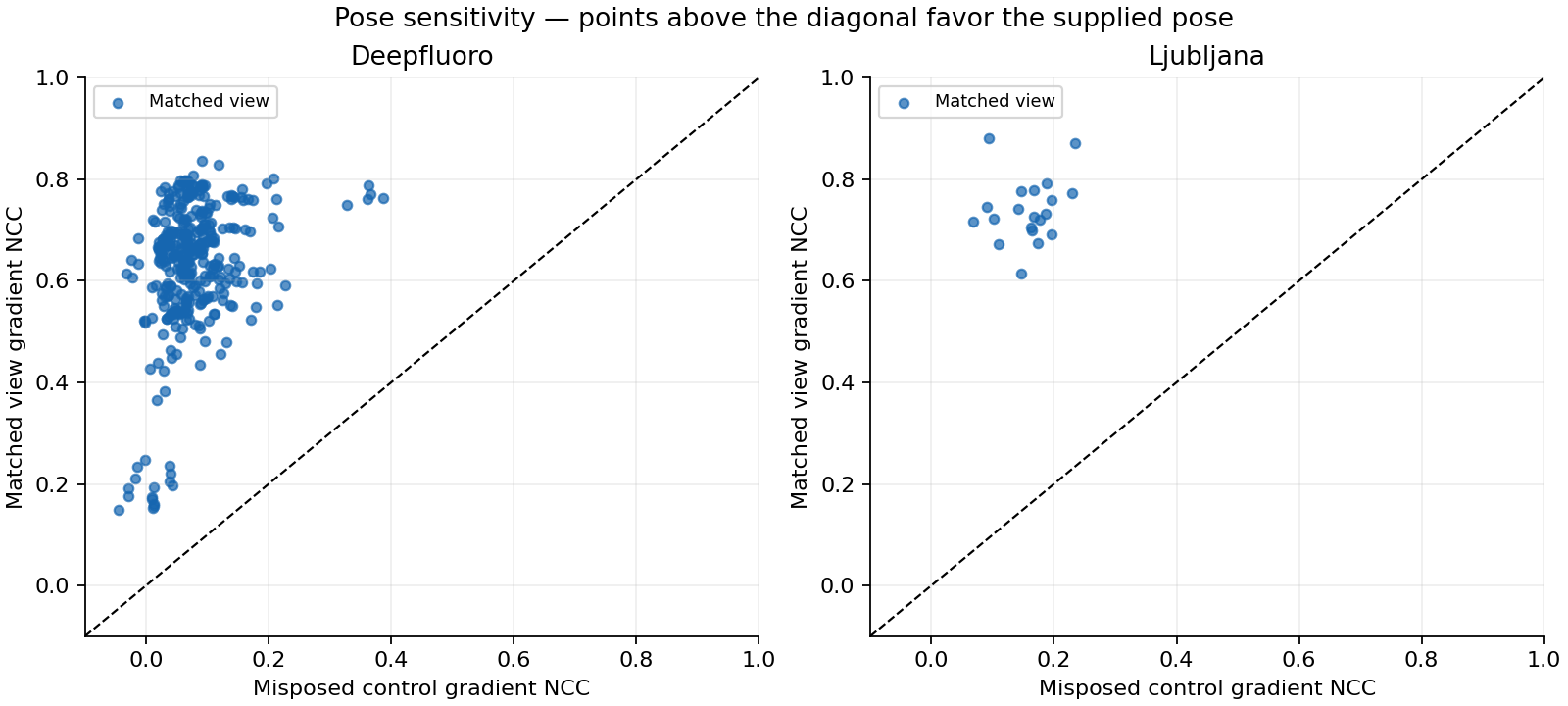
| DeepFluoro | 6 | 362 | 0.939 | 0.681 | 0.850 | 362/362 |
| Ljubljana | 10 | 20 | 0.840 | 0.737 | 0.641 | 20/20 |
Per-subject gradient NCC ranges from 0.536 to 0.755 for DeepFluoro and from 0.698 to 0.799 for Ljubljana. subject02's lower scores reflect a CT volume cropped through the body; the validation guide explains this and subject03's truncation. On Ljubljana's model-defined vessel ROI the median NCC is 0.858 and gradient NCC 0.737.
“Matched beats misposed” compares gradient NCC against an independently rendered control with an additional 5 mm translation along simulator X and 5° rotation about simulator world Z, using the same reference and detector ROI.
Changes since the previous report#
The previous version of this report (simulator commit 8b3753f) rendered the
same views with the same protocol. Two adapter conventions have since been
corrected; the renderer and the metrics are unchanged.
| Dataset | Report | NCC | Gradient NCC | Shape SSIM | Matched beats misposed |
|---|---|---|---|---|---|
| DeepFluoro | previous | 0.936 | 0.623 | 0.836 | 362/362 |
| DeepFluoro | this run | 0.939 | 0.681 | 0.850 | 362/362 |
| Ljubljana | previous | 0.253 | 0.219 | 0.570 | 15/20 |
| Ljubljana | this run | 0.840 | 0.737 | 0.641 | 20/20 |
- Principal-point sign. The stored
x0/y0are principal-point offsets from the image centre along image columns and rows. The previous adapter mirrored the horizontal offset, displacing each Ljubljana render by2·x0/pitch(up to 92 binned pixels); the previous report's offset-sign diagnostic is this correction, and its Ljubljana scores equal this run's. Geometry is now set byCarmGeometry.principal_point_px. DeepFluoro's offsets are half a native pixel, so its renders move by only a quarter of a binned pixel. - DeepFluoro voxel origin. The DeepFluoro poses in this release treat NIfTI
indices as voxel corners (voxel
ijkataffine @ (ijk + 1/2)). Rendered with voxel centres ataffine @ ijk, every subject sat about one binned pixel off its references in the same direction. Ljubljana poses expect voxel centres. The adapter records this per dataset inPOSE_VOXEL_ORIGIN.
Residual misalignment, measured by edge-based phase correlation between each render and its reference, is now 0.19 binned pixels RMS for DeepFluoro and 0.26 for Ljubljana, with no systematic shift. The evidence for both conventions is in the dataset guide. The offset-sign diagnostic render was removed from the scripts.
Numerical checks#
- All 382 expected pairs completed and have finite metrics and correctly shaped reference/generated arrays.
- The first eligible view of each of the 16 subjects was also rendered with a 0.25 mm integration step, compared with the main 0.5 mm run. The maximum relative L2 difference in attenuation was 0.428%. This is a numerical consistency check, not an external accuracy measurement.
- The run used a clean checkout. All 18 simulator source hashes recorded before the run match the committed sources.
Methods#
| Item | Configuration |
|---|---|
| Input release | eigenvivek/xvr-data, revision a17273e3eadbd793bd861f3598a80ce4590c1124 |
| Pairing | Matching subject volume, supplied pose and per-view detector intrinsics through xray_simulator.validation.xvr |
| Geometry conventions | Principal point at ((W-1)/2 + x0/dx, (H-1)/2 + y0/dy); DeepFluoro voxel ijk at affine @ (ijk + 1/2), Ljubljana at affine @ ijk. Fixed per dataset; no registration or pose fitting |
| Sampling | 4×4 detector binning; 0.5 mm ray integration step |
| DeepFluoro crop | 50 pixels from each edge before binning: 1536×1536 to 1436×1436, then 359×359 |
| Exclusions | Upstream-flagged DeepFluoro subject01 003/050 and subject04 002/004; Ljubljana uses frontal/lateral primary views, excluding _max images |
| DeepFluoro volume | Example HU mapping: center 200, width 1600, maximum attenuation coefficient 0.05/mm |
| Ljubljana volume | Uncalibrated vessel-contrast proxy: max(stored_value, 0) × 5e-6 per mm; the same coefficient for all subjects; not treated as HU |
| Primary ROI | Central 90% of each cropped detector, excluding a 5% margin per edge, fixed before scoring; not an anatomical segmentation |
| Secondary Ljubljana ROI | Detector ROI intersected with projected vessel support above 1e-4 attenuation, dilated by 10 pixels; model-defined, not independently annotated |
| Reference display | Unsigned 16-bit DICOM divided by 65535; the X-ray counterpart is its opposite polarity |
| Display variants | Default log window [0,6], and a separate subject window derived from attenuation percentiles 1/99 of the first generated view and then frozen |
| Statistics | Per-view scores, per-subject medians and quartiles, and median of subject medians; no confidence interval from views of unestablished acquisition independence |
For the structural comparison, let s be the reference scaled by its minimum
and maximum within the detector ROI and clipped to [0,1]. DeepFluoro uses
log(2 / (1 + s)) / log(2) as its reference proxy, following the upstream xvr
preprocessing with an explicit final unit scale. Ljubljana uses 1 - s for its
subtraction angiograms, without a second logarithm. These proxies are compared
with simulated attenuation divided by the fixed default window width, 6, without
clipping. Metric settings are data_range=1, histogram range [0,1], and 64 bins.
Reference contrast previews in the local gallery are for visual inspection. Display scores use the fixed stored reference scale. The generated subject window is derived only from the simulator output; it is not fitted to the real image. The protocol records the full settings, package versions and simulator source hashes. Metric definitions are in the validation guide.
Interpretation and limits#
The evidence supports anatomical and projection-structure agreement on both
datasets with the supplied poses and calibrations. The two geometry conventions
were identified from these same views; the Ljubljana sign follows an exact
2·x0/pitch relationship and matches upstream xvr's own correction, while the
DeepFluoro voxel origin is an empirical property of this data release that has
not been confirmed by its authors.
Both X-ray and fluoroscopy appearances use the same simulated transport with opposite display polarity. These are still images, not independent simulations of different exposures or a fluoroscopy cine sequence. This experiment does not validate absolute attenuation, scanner brightness, dose, noise, scatter, detector lag, motion or temporal behavior. Ljubljana's vessel mapping is explicitly uncalibrated. Instruments, collimation, truncation, contrast filling and acquisition processing can affect agreement. No scanner parameters were fitted on training subjects and evaluated on held-out subjects.
Artifacts#
- Dataset summaries.
- Per-subject summaries, including quartiles.
- Per-view metrics: 382 rows. The
directorycolumn identifies the pair within the local rendering output; it is not a link to public patient imagery. - Full numerical report index:
pair_fileslinks to the numerical measurements and geometry for all 382 pairs, including display measurements. Pair contents are unchanged from the local report. - Integration checks, completion status and run verification.
- PDF summary figure.
- Publication provenance, including hashes of the original report and run scripts.
The public report contains numerical measurements and metric plots. Source volumes, reference/generated anatomy images, raw arrays and the interactive image gallery remain in the local run directory. This follows the dataset guide: DeepFluoro is CC BY-NC 4.0; Ljubljana is CC BY-NC-ND 4.0, with the xvr remix hosted by permission. The simulator's license does not relicense those datasets or derived imagery.
Reproduce locally#
The rendering script preserves the run logic, with local
paths configured through environment variables. Its optional inventory hash is
recorded when a manifest.json exists above the data directory; this run had
none. The report builder reconstructs the local image
gallery, plots and CSVs from a complete rendering output. Generated images remain
local.
Use the pinned simulator commit above and obtain the dataset separately following
the dataset guide. Install the rendering/validation extras and Matplotlib in a
CUDA-capable environment; exact versions from this run are in protocol.json.
From a checkout containing these report scripts:
export I4H_SENSOR_SIMULATION_REPO=/path/to/simulator-at-recorded-commit
export I4H_VALIDATION_DATA_ROOT=/path/to/xvr-data
export OPENBLAS_NUM_THREADS=1
export OMP_NUM_THREADS=1

python xray-simulator/docs/reports/deepfluoro-ljubljana/render_and_compare.py \
  --output /path/to/new-local-render-output
python xray-simulator/docs/reports/deepfluoro-ljubljana/build_local_report.py \
  /path/to/new-local-render-output
I4H_VALIDATION_DATA_ROOT is the directory containing deepfluoro/ and
ljubljana/. Use a new output directory. The full run requires the six
DeepFluoro and ten Ljubljana subject volumes and their primary DICOM/PT view
companions. The scripts do not download datasets or publish outputs.
Host-specific protocol paths are replaced by placeholders in this public
snapshot; measurements are unchanged.
Sources#
- xvr-data release, pinned revision above.
- DeepFluoro: Grupp et al., Automatic annotation of hip anatomy in fluoroscopy for robust and efficient 2D/3D registration, 2020.
- Ljubljana 3D-2D-GS-CA: Mitrović et al., 3D-2D registration of cerebral angiograms: A method and evaluation on clinical images, 2013.
- Pinned xvr reference preprocessing.
- xvr x0 sign correction.